Excavation works form a large part of the construction industry in Singapore, especially for basements, underground infrastructure, and foundations. Ground stability is critical, as buildings, roads, and utilities are often located close to construction sites.
Engineers use Earth Retaining or Stabilizing Structures (ERSS) to tackle these issues by supporting excavations and controlling soil movement.
For contractors, developers, and project managers, understanding ERSS in Singapore is important to plan safe excavation works, meet regulatory requirements, and minimize construction risks.
What Is ERSS in Construction?
ERSS refers to engineered systems designed to retain soil and maintain ground stability during excavation or construction.
These systems are successfully used for basement construction, underground infrastructure, foundation works, and deep excavations.
An ERSS may comprise retaining walls, steel struts, ground anchors, and other support components depending on the requirements of the project.
The main purposes of ERSS are to:
- Support soil around excavation boundaries.
- Control ground movement and retaining wall deformation.
- Reduce risks to nearby buildings and underground utilities.
- Maintain excavation stability during construction.
A suitable system should be selected after careful consideration of the soil conditions, depth of excavation, groundwater, and surrounding structures.
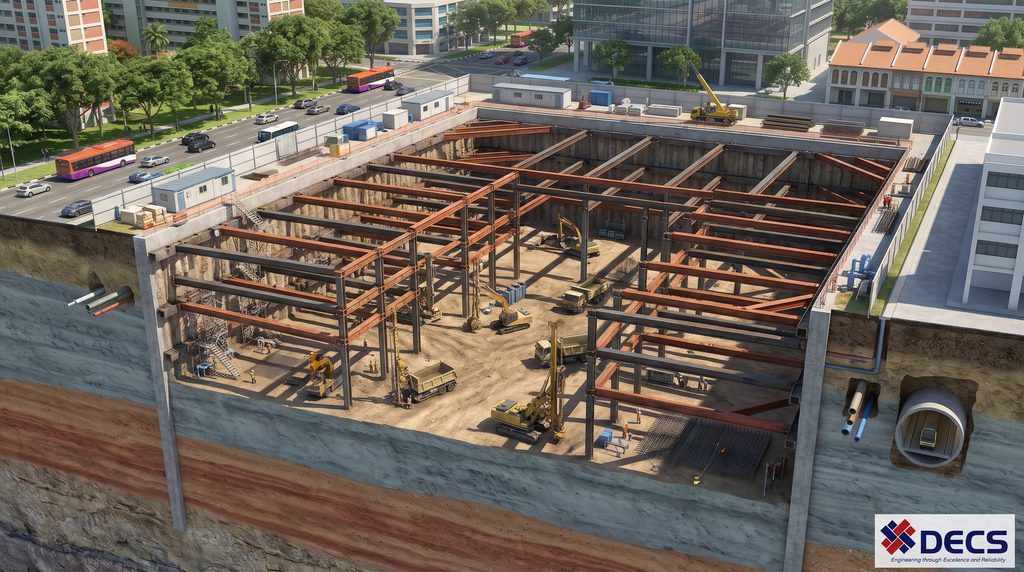
Earth retaining and stabilising structures supporting a deep excavation
Common Types of ERSS Used in Singapore
Different retaining techniques are appropriate for various construction needs and ground conditions.
1. Sheet Pile Walls
Sheet pile walls consist of interlocking steel sections installed into the ground to create a continuous retaining barrier. They are commonly considered for temporary excavation support and trench construction.
2. Diaphragm Walls
Diaphragm walls are reinforced concrete retaining structures often used for deep excavations. Their stiffness helps control ground movement, making them suitable for certain projects near existing buildings and infrastructure.
3. Secant Pile Walls
Secant pile walls are formed using overlapping bored piles. They can provide excavation support in restricted construction areas and may help control groundwater movement when appropriately designed and constructed.
4. Contiguous Bored Pile Walls
These systems use closely spaced bored piles to retain soil. Depending on ground and groundwater conditions, additional measures may be needed to manage seepage.
5. Braced Excavation Systems
To withstand lateral earth pressures and preserve retaining wall integrity throughout various construction phases, deep excavations may need internal steel struts and supporting components.
The best ERSS is determined by structural specifications, construction techniques, and geotechnical investigations unique to the project.
Key ERSS Design Considerations
Before excavation starts, engineers must evaluate a number of technical aspects for an efficient ERSS design.
Ground characteristics: The design of retaining walls and the stability of excavations are influenced by the strength, stiffness, and subterranean characteristics of the soil.
Excavation Depth: Stronger retaining structures, more support systems, and well-thought-out excavation sequences may be necessary for deeper excavations.
Groundwater Management: Groundwater evaluation and control are crucial because water pressure and seepage can impact excavation stability.
Nearby Structures: Where nearby buildings, roadways, and subterranean utilities might be impacted, excavation-related ground movement needs to be evaluated.
Monitoring Requirements: During construction, engineers can keep an eye on the real ground and structural behaviour with the use of tools like inclinometers and settlement markers.
Before construction begins, these factors assist project teams in identifying risks and creating appropriate engineering solutions.
ERSS Design Requirements in Singapore
The Building and Construction Authority (BCA) oversees the relevant building control regulations that apply to ERSS projects in Singapore.
Regulatory procedures may include design submissions, qualified individuals, independent verification, specialized geotechnical assessments, and permissions, depending on the project.
Some geotechnical construction projects require specific legal requirements for excavations deeper than six meters. However, this threshold does not mean that all shallower excavation projects are excluded.
Based on the nature of the proposed work, site conditions, and existing rules, project teams must evaluate the relevant requirements.
Official reference: Building and Construction Authority (BCA), Singapore.
Common ERSS Challenges in Construction Projects
Even with a well-developed design, excavation projects can face unexpected technical challenges.
- Unexpected Soil Conditions: Differences between investigation results and actual ground conditions may require design reassessment.
- Ground Movement: Excessive settlement or retaining wall movement can create risks for nearby structures.
- Groundwater Issues: Uncontrolled seepage or water pressure can affect excavation stability and construction progress.
- Construction Coordination: Changes to excavation sequences, temporary supports or construction methods may affect the performance of retaining systems.
Early technical coordination, appropriate monitoring, and timely engineering reviews are important for managing these challenges.
Supporting ERSS Projects with Geotechnical Engineering Expertise
Reliable excavation support starts with understanding ground conditions, structural requirements, and construction constraints.
DECS supports civil and infrastructure projects in Singapore through its geotechnical engineering design and detailing services, helping project teams address excavation support requirements and technical design challenges.
For projects involving earth retaining structures or deep excavations, connect with DECS to discuss suitable engineering design support.
Frequently Asked Questions
What does ERSS stand for?
ERSS stands for Earth Retaining or Stabilizing Structures. These systems retain soil and help maintain ground stability during excavation and construction works.
Is ERSS required for every excavation in Singapore?
Not every excavation requires the same ERSS arrangement. The appropriate retaining system and regulatory requirements depend on site conditions, excavation characteristics, and applicable regulations.
Why is geotechnical investigation important for ERSS?
Geotechnical investigation provides information about soil and groundwater conditions, helping engineers assess excavation stability, retaining wall requirements, and potential impacts on surrounding structures.