
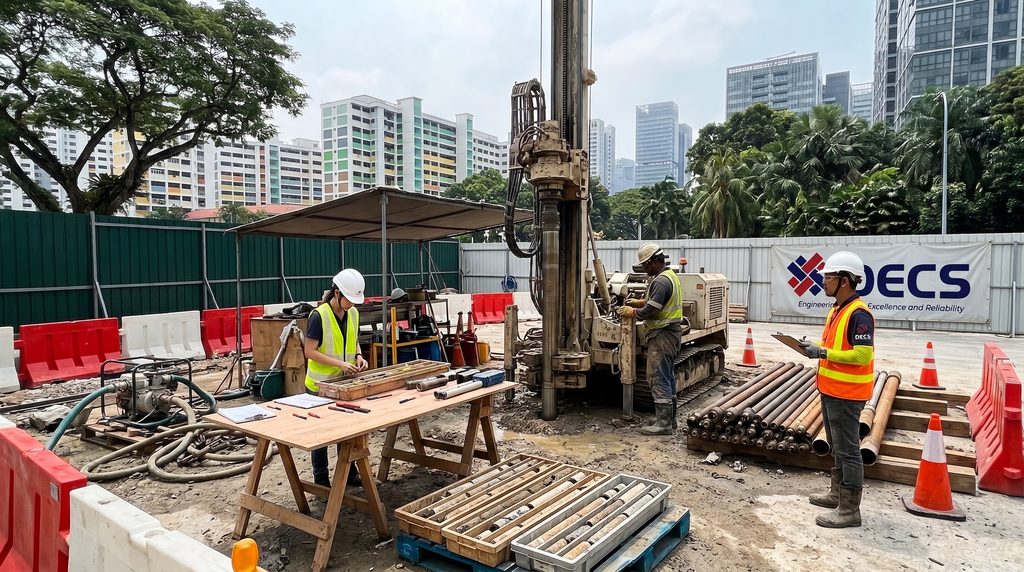
Soil investigation helps engineers assess ground conditions before foundation design and construction.
Before construction begins, one of the most important questions is frequently hidden beneath the ground: what exactly will the building stand on?
A site may appear to be suitable for development on the surface, but the conditions beneath can be quite different. Soft soil, varying rock layers, groundwater, and unexpected ground conditions can all have an impact on foundation design, excavation techniques, and construction costs.
This is why soil testing and site investigations are critical components of construction project planning in Singapore.
Understanding the ground early helps developers, contractors, and engineering consultants reduce uncertainty and make better decisions throughout the project.
What Is Soil Testing in Construction?
Soil testing examines the physical and engineering properties of soil to determine how it will behave under various loads and construction conditions.
Soil testing in construction is usually part of a larger ground or site investigation program. Depending on the project, borehole drilling, field testing, laboratory analysis, and groundwater observations may all be required.
The goal is to collect reliable information about the ground before making major engineering decisions.
For example, a soil investigation can assist engineers in determining:
- The types of soil and rock present beneath a site.
- How soil strength and stiffness vary with depth.
- Whether the ground can support the proposed structural loads.
- How groundwater may affect excavation and foundation works.
- Whether settlement or ground movement could become a concern.
These findings provide essential information for geotechnical engineering design, particularly when planning foundations, retaining structures, and underground construction works.
Why Is Soil Testing Important Before Construction in Singapore?
Singapore has a varied geological environment. Ground conditions can vary significantly between locations, and even within the confines of a single development site.
Some projects use soft marine clay or fill material, while others use residual soils, weathered rock, or more complex geological profiles.
These distinctions are significant because the same foundation or excavation solution may not be suitable for all sites.
1. Selecting Suitable Foundation Systems
A foundation transfers a building’s weight into the supporting ground.
However, the appropriate foundation system is determined by factors such as structural loading, soil strength, compressibility, groundwater conditions, and the depth of suitable bearing strata.
For certain developments, shallow foundations may be technically feasible. Others may require bored piles, driven piles, or other specialized foundation solutions.
Instead of making assumptions about the ground, engineers can use soil investigation results to evaluate these options
2. Reducing the Risk of Unexpected Ground Conditions
Unexpected ground conditions might cause problems once work has begun.
For example, meeting weaker soil than anticipated may necessitate more assessment, design alterations, or modifications to the construction approach.
Similarly, groundwater conditions that differ from the initial assumptions may have an impact on excavation stability and temporary work planning.
Adequate research cannot eliminate all underground uncertainties. However, it can assist in identifying possible problems sooner, when engineering teams have greater leeway to address them.
3. Supporting Safe Excavation Works
Excavating becomes especially difficult when construction takes place near existing buildings, roads, subsurface pipes, or infrastructure.
The design of Earth Retaining and Stabilising Structures (ERSS) is dependent on a solid understanding of soil behaviour, groundwater pressures, and potential ground movement.
Without enough ground information, forecasting how an excavation will affect its surroundings becomes more challenging.
4. Improving Construction Cost Planning
Poor ground information can lead to unforeseen costs.
If site circumstances necessitate changes to foundation designs or building methods, a project may incur more engineering work, materials, equipment requirements, or schedule revisions.
Early soil analysis promotes more informed budgeting by assisting design teams in identifying ground-related restrictions before making major construction decisions.
Common Soil Investigation Methods Used in Singapore
Different investigation methods yield various types of geotechnical knowledge. Engineers select appropriate methods based on project needs, geological conditions, and design factors.
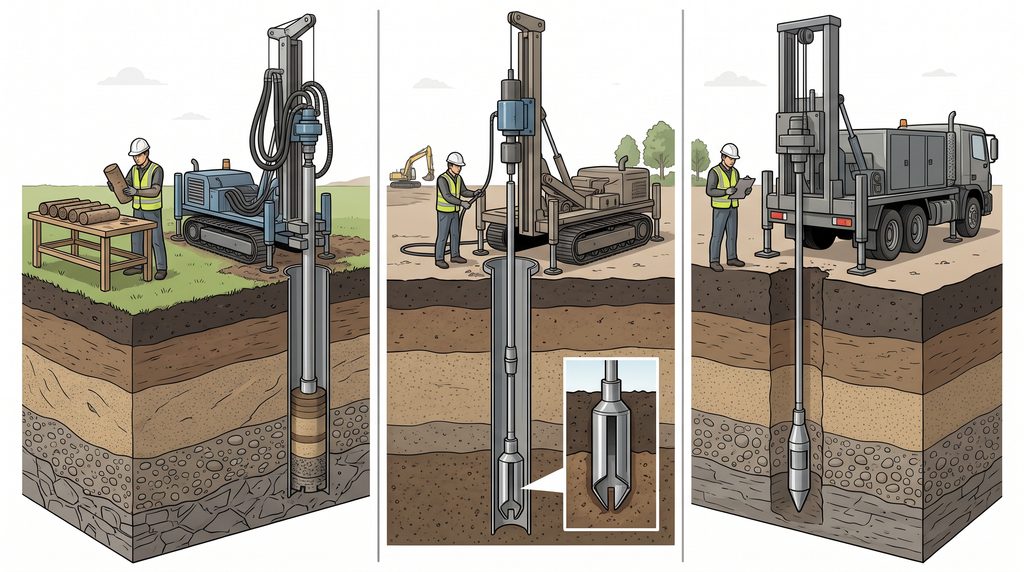
Borehole drilling, SPT, and CPT provide different types of ground information for geotechnical assessment.
Borehole Drilling and Soil Sampling
Boreholes allow investigators to evaluate soil and rock conditions below ground.
Samples collected during drilling can be analysed and evaluated to learn about soil classification, strength, and other important features.
Borehole logs also help engineers determine the order and thickness of various ground strata.
Standard Penetration Test (SPT)
The Standard Penetration Test is often used in boreholes.
It measures the resistance experienced when driving a standard sampler into the ground according to a predefined testing technique.
The resulting SPT N-values are useful for ground characterisation and, when understood correctly, may support engineering assessments.
However, SPT data should not be interpreted as a thorough picture of soil behaviour on their own.
Cone Penetration Test (CPT)
Cone penetration testing entails inserting an instrumented cone into the ground to determine penetration resistance and, depending on the equipment, other parameters such as pore water pressure.
CPT can produce a rather consistent profile of ground resistance with depth.
The applicability of CPT depends on the ground conditions and the investigation’s aims. It also does not eliminate the requirement for proper sampling and laboratory testing in situations where they are essential.
Laboratory Soil Testing
Laboratory testing aids in the determination of engineering qualities that field tests alone may not sufficiently establish.
Depending on the project, testing may look at moisture content, particle size distribution, plasticity, shear strength, compressibility, and other relevant properties.
Each test helps to a better knowledge of how the soil will function during construction and throughout the structure’s life
How Do Soil Investigation Results Influence Geotechnical Design?
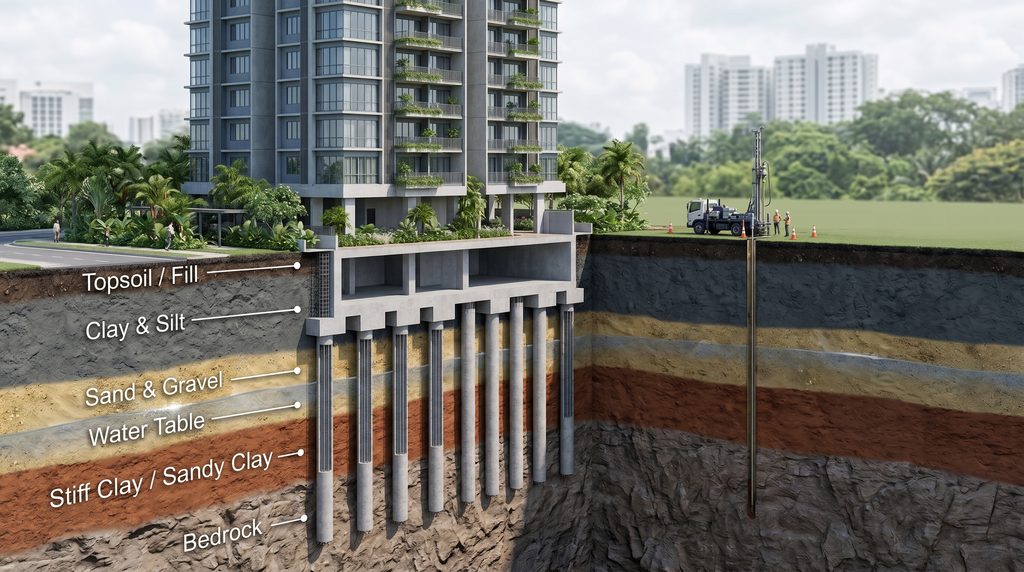
Geotechnical engineering design uses soil investigation findings to assess foundation performance and ground-related risks.
Collecting soil data is just the beginning. The next challenge is accurately interpreting such data and applying it to engineering decisions.
Borehole recordings, test findings, geological descriptions, and groundwater observations are all possible components of an investigative report. Engineers must weigh these data against the anticipated development, loading conditions, and surrounding environment.
This is where geotechnical design is really crucial.
The data can be used in foundation design to evaluate bearing resistance, settlement, pile behavior, and appropriate founding depths.
Engineers may consider lateral earth pressures, groundwater effects, retaining wall performance, and the potential influence on surrounding structures when planning deep excavation projects.
Ground knowledge is useful for establishing relevant strength parameters and assessing stability under applicable loading and groundwater conditions when working on slopes.
A well-planned study can therefore support more than just regulatory documents. It establishes the technological basis for design decisions.
Singapore’s BCA Requirements for Site Investigation
Soil inquiry is also a regulatory requirement for construction projects in Singapore.
Regulation 31 of the Building Control Regulations requires the appointed Qualified Person to conduct a suitable site investigation for applicable foundations, tunnelling, site formation, and earthworks.
Investigations must be adequate to determine the ground and groundwater conditions relevant to the proposed works.
The Building and Construction Authority (BCA) also issued its Guideline on Requirements for Site Investigation (SI) reports on 1 September 2025.
The guideline takes effect for new project applications submitted to the Urban Redevelopment Authority (URA) for Planning Permission on or after March 1, 2026, as well as site research reports dated on or after March 1, 2026.
Standardised report forms are one of the prerequisites, as is certification by an appropriate professional engineer.
BCA also emphasizes the necessity of early collaboration among developers, qualified persons, and consultants to ensure that proper investigative methodologies and testing requirements are incorporated throughout project design.
Project teams should refer to the official BCA structural plan submission guidelines and applicable regulations for their particular works.
What Happens When Soil Investigation Is Inadequate?
Consider a project that necessitates a basement excavation near existing structures.
If the initial investigation fails to detect weak soil layers or relevant groundwater conditions, the engineering team may need to reconsider their assumptions as new evidence becomes available.
This could result in more inquiry, updated retaining structure calculations, or adjustments to the excavation sequence.
Changes in building stages may have an impact on project costs and timetables.
The same idea applies to foundation design. When good soil information is unavailable, design assumptions may need to be examined before the best foundation option can be determined.
A more thorough inquiry does not always result in a faster or cheaper project. Its benefit comes from decreasing needless ambiguity and promoting proportional, evidence-based engineering decisions
What Should Developers Check Before Starting Soil Investigation?
For developers and contractors preparing a construction project in Singapore, a practical starting checklist includes:
- Review the proposed development: Consider the structural layout, building loads, basement requirements, and intended construction methodology.
- Understand the available ground information: Review existing geological records, relevant site history, and available nearby investigation data.
- Engage the appropriate engineering professionals early: Coordinate with the appointed qualified person and geotechnical consultants to identify investigation objectives.
- Define the investigation scope: Determine suitable borehole locations, investigation depths, field tests, and laboratory tests based on project-specific needs.
- Consider surrounding constraints: Identify nearby buildings, utilities, transport infrastructure, and other features that may influence the investigation or design.
- Review the findings before finalising design assumptions: Ensure the available ground information adequately supports the intended foundation and excavation designs.
The investigation programme should be determined by competent professionals rather than applying the same number of boreholes or tests to every development.
How DECS Supports Geotechnical Engineering Projects in Singapore
Site investigation findings become most valuable when they are correctly translated into practical engineering solutions.
DECS provides geotechnical design and detailing services in Singapore, supporting contractors, developers and engineering consultants across civil and infrastructure projects.
Its geotechnical engineering design capabilities include ground investigation review, geotechnical assessments, foundation planning, pile foundation design, ERSS design, slope stability analysis, and relevant engineering documentation.
DECS also supports the coordination of geotechnical designs and submissions in accordance with applicable BCA, LTA, and PUB requirements.
By integrating ground information with structural design considerations and project-specific constraints, engineering teams can make more informed decisions during development planning and construction.
Conclusion
Understanding the ground conditions is the first step toward successful construction.
In Singapore, where development projects frequently entail complex ground conditions, underground infrastructure, and adjacent structures, accurate soil analysis is an essential component of prudent engineering planning.
For developers and contractors, the goal is not just to execute soil tests. The goal is to guarantee that the findings serve as a solid foundation for foundation selection, excavation planning, and safe, practical design selections.
Planning a construction or infrastructure project in Singapore?
DECS provides professional geotechnical design, ground investigation evaluation, and foundation engineering support tailored to your project needs.
Frequently Asked Questions
Is soil testing necessary before construction in Singapore?
Site investigation is required for relevant works under Singapore’s Building Control Regulations. The extent and methods depend on the proposed works, site conditions, and applicable requirements. The appointed qualified person is responsible for ensuring that the investigation is adequate.
What is the difference between soil testing and geotechnical investigation?
Soil testing generally refers to field or laboratory tests used to determine soil characteristics. Geotechnical investigation is broader and may include desk studies, boreholes, testing, groundwater observations, and engineering interpretation.
How long does soil testing take in Singapore?
The duration depends on site access, investigation scope, borehole depth, ground conditions, laboratory testing, and reporting requirements. Complex projects may require more extensive investigation, so the programme should be established based on the actual scope of work.
Can poor soil conditions affect foundation design?
Yes. Weak or compressible soils, variable ground profiles and groundwater conditions can influence foundation selection, founding depth, settlement assessments and construction methodology. The appropriate solution must be established through engineering analysis.
How does geotechnical engineering design relate to soil investigation?
Soil investigation provides information about ground conditions. Geotechnical engineering uses this information to evaluate and design foundations, retaining structures, excavations, and other ground-related works in accordance with the relevant project requirements.